



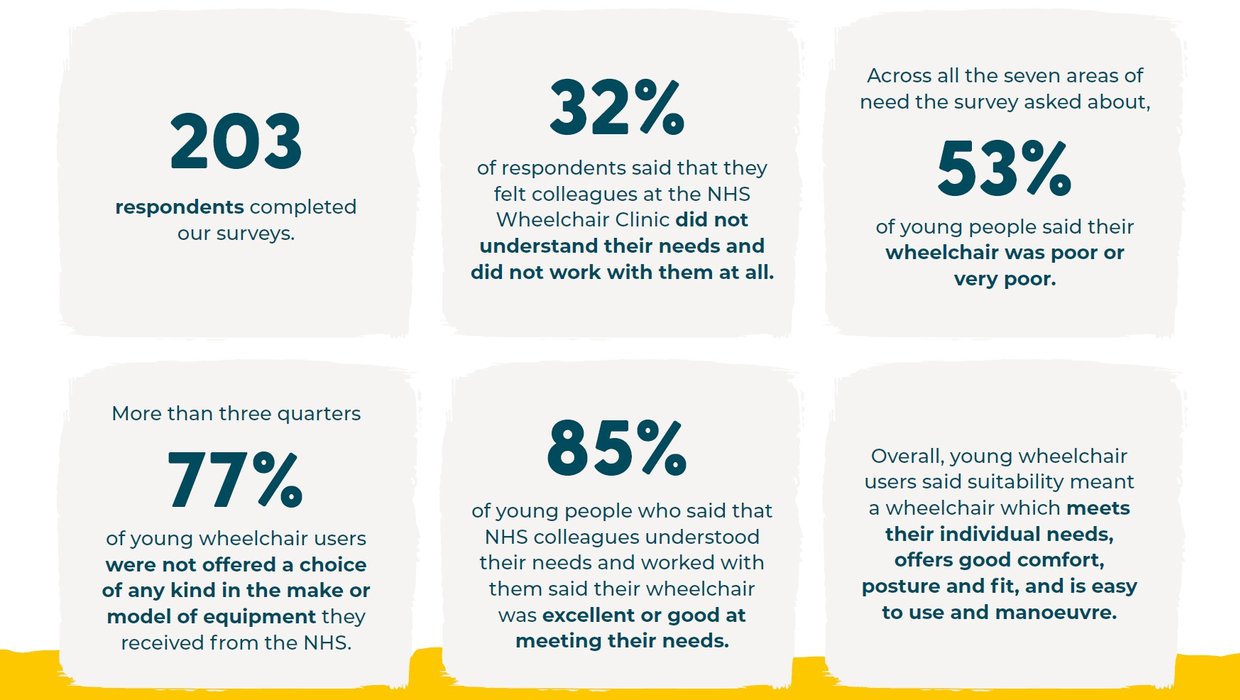
Whizz Kidz is pleased to share the Mobility Matters report, following a survey of more than 200 young wheelchair users and their families. The report discusses the suitability of mobility equipment supplied by the NHS to young people – here is a snapshot of our key findings:

Youth Board NHS Full Report

Each NHS Wheelchair Service is run by the Integrated Care Board (ICB) for that local area. Research has revealed there are significant differences in how services operate. Therefore, there are equally significant differences in the experience young wheelchair users, and their families, have in accessing services. Since 2010, the NHS has released several iterations of guidance and frameworks outlining how NHS Wheelchair Services aim to deliver their services. Generally, focus is placed on providing a holistic, person-centred approach which promotes independence and individual goals and lifestyles.
The Youth Board have raised the issue of suitability of the equipment provided to young wheelchair users by National Health Service (NHS) Wheelchair Services. From their own personal experiences, they have reflected on the vast difference in provision across different areas of the country. Anecdotally, young wheelchair users and their families have often told Whizz Kidz that the equipment they receive from NHS Wheelchair Services is not always suitable. We have also witnessed an unprecedented rise in applications to our Wheelchair and Equipment Service, leading to the unprecedented decision to temporarily close our equipment waitlist in February 2025.
The analysis of survey responses revealed that, whilst there are pockets of good practice where NHS colleagues were doing the best they could with the resources available, young wheelchair users found their NHS equipment to be falling short. Generally, young people did not feel their equipment was suitable. Young wheelchair users repeatedly shared they wanted more choices and greater involvement in the process and for their needs to be better understood. Despite this, there were examples of success, and these largely occurred when young people reported their needs being understood and clinicians working with them.
This report has found that much of the theoretical guidance that should underpin how NHS Wheelchair Services are run aligns well with what young wheelchair users and their families would like to see. However, there remains a resounding gap between the issued guidance and the reality of how NHS Wheelchair Services operate. Many of the shortcomings’ families shared in their survey responses mirror those that have been raised in the past. The long-standing critiques indicate that, despite the changes made to guidance and delivery of NHS Wheelchair Services over the past 15 years, little impact has been felt by young wheelchair users.
My son didn’t need to leave his disability buggy to get measured as they knew this could be distressing. Also gave me options on how I’d like the chair, things like is it better to get cushions on the sides or adapt the chair for a snug fit etc.”
Listen to my perspective as the person using the wheelchair. Not belittle my suggestions and understand the impact an incorrectly set up / fitted wheelchair has on my life.”
There is no choice, the chair is basic and poor quality, it provides some independence but is based on cost.”
Youth Board NHS Full Report
Youth Board NHS Full report Cymraeg

Youth Board NHS Summary Report
Youth Board NHS Summary Report Cymraeg