A close up of a smart looking wheelchair with an orange frame. A young wheelchair user has their right hand on one of the wheels.

Knowing the parts of your wheelchair

Understand what the different parts of a wheelchair do and how they work. Access our helpful guide with illustrations.

Content warning

The information and guidance on the Whizz Kidz Hub are for information and educational purposes only. We make no guarantees that the information is complete, safe, or suitable for every individual. Children and young people should be supervised when accessing or attempting any activities shown. We accept no liability for any injury, loss or damage arising from its use. 

This was written by...

Pheonix Young And Richard Cheshire

How well do you know your wheelchair? In this guide, we’re going to walk you through the parts of your wheelchair, naming every part and describing what it does. As well as helping you to name each part, you’ll have the confidence to identify problems and get them sorted out.

The parts on your wheelchair are pretty much universal. There is a wide range of wheelchairs on the market, so this guide doesn’t go into specifics or use brand names or terms. 

What you’ll learn:

  • The names of each part of your manual or powerchair.
  • What each part does and why it’s important.
  • How to spot some common problems with both manual wheelchairs and powerchairs.

What you need to know about the parts of your wheelchair

Wheelchairs are fairly simple pieces of technology that are built to a standard design. While you can find wheelchairs from different brands and manufacturers, the terms for each part are the same. That means once you’ve learned them all, you’ll know all you need to know.

There are some differences between the parts of manual wheelchairs and powerchairs, so we’ve split them into two sections.

Parts of a manual wheelchair

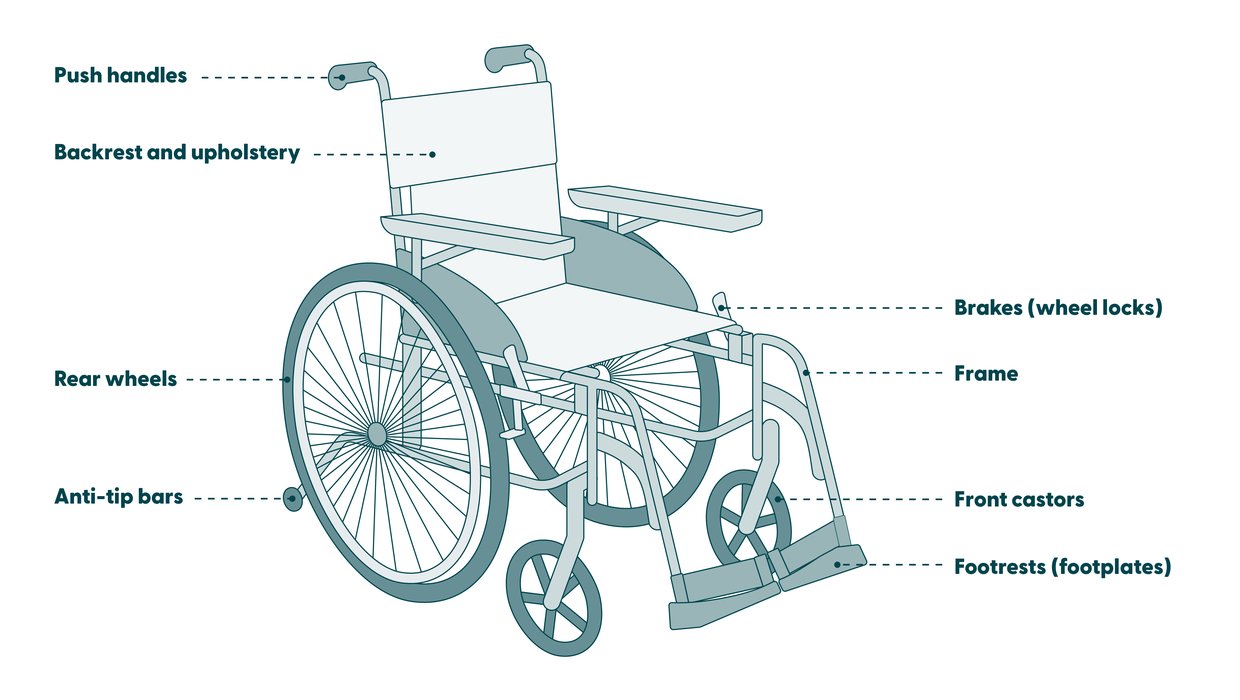
Manual wheelchairs don’t have a joystick or a motor, which makes them much simpler mechanically. Here are all the parts on your manual wheelchair:

  • Frame: The frame is the main structure that supports the chair. Frames can be made from aluminium, steel, or carbon fibre. The challenge is to balance strength with weight. You’ll want a chair that’s durable to stand-up to the elements.
  • Push handles: The chair’s push handles are located at the top of the backrest. They help someone push the wheelchair safely and comfortably. Watch out for damaged hand grips.
  • Backrest and upholstery: The backrest provides support for your back and comfort. They can be made from fabric, (or rigid panel) and keep the wheelchair user upright and stable. Keep an eye out for nicks, chips, rips and damage.
  • Armrests: Your chair’s armrests provide support for your upper body (as well as somewhere comfortable to rest your arms!). You’ll find that some lift up or detach to make it easier to move and manoeuvre the chair.
  • Brakes (wheel locks): The brakes are operated by small levers near the rear wheels. They are designed to stop the chair from rolling when you’re stationary (and not to help you slow down). Check the brakes are working every time you get into your chair.
  • Rear wheels: The large wheels at the back of the chair are used for pushing yourself forward. Each rear wheel has a hand rim (a circular bar around the wheel) that gives you grip and control. The rear wheels have a tyre which provides traction. Always check wheels run smoothly and that tyres are inflated and in good condition.
  • Front castors: The small swivel wheels at the front are called castors. They help you to turn smoothly and steer with precision. 
  • Seat base: The seat base is the flat surface you sit on. Depending on the chair, it can be padded or shaped to be more comfortable and help your posture.
  • Footrests (footplates): Some people call them footrests, others footplates. Whatever you call it, they’re there to support your feet and legs. On most chairs, you can adjust their  height and angle for comfort. Some can swing away or detach to help access.
  • Anti-tip bars: Not all chairs have these, but they’re small stabilisers at the back that stop the chair tipping backwards. Anti-tip bars are  especially useful on slopes or ramps.

Parts of a powerchair

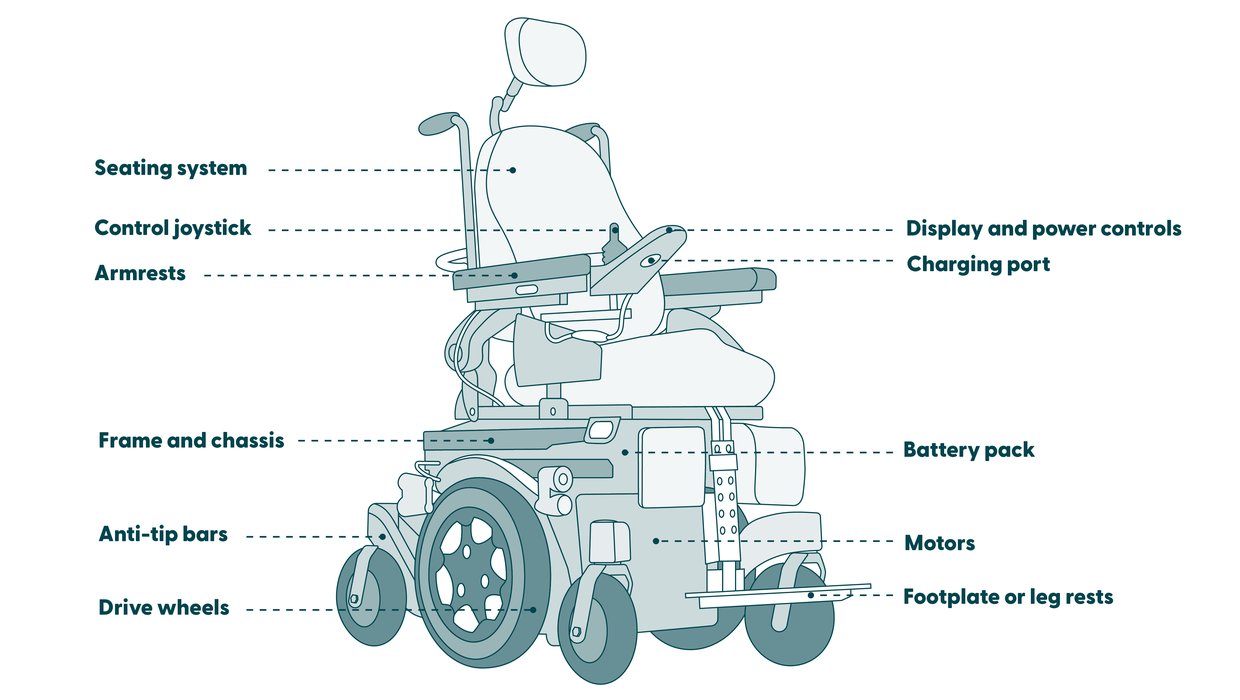
Manual wheelchairs and powerchairs share many of the same parts, but there are also some crucial differences (a motor and a joystick to start!). Here are all the parts on your powerchair.

  • Control joystick: The joystick is mounted on the armrest and controls the direction and speed of the chair. Some models use alternative controls (including chin, head, or switch) depending on the needs of the user.
  • Display and power controls: The display shows the health of your chair, with information on  battery level, speed settings, and system status. It also includes the main on/off switch.
  • Seating system: The seating systems on a powerchair includes the seat base, backrest, and headrest. These are often fully adjustable and sometimes powered, with some chairs having tilt, recline and elevate functions.
  • Armrests: Armrests provide comfort and support. On powerchairs, they’re often adjustable, with the height and width fitting around the user.
  • Frame and chassis: The frame and chassis on a powerchair are strong and stable, providing the structural base that houses the batteries, motors, and electronics. 
  • Drive wheels: The drive wheels are the main powered wheels that move the chair. Depending on the specific type of chair, the drive wheels can be at the front, in the middle or at the rear of the chair. 
  • Castor wheels: The small swivel wheels at the front are called castors. They help you to turn smoothly and steer with precision. 
  • Footplate or legrests: The footplate or legrests provide support for your legs and feet. You’ll find some chair models can lift, extend, or tilt electronically for extra comfort and to improve circulation.
  • Battery pack: The battery pack supplies power to the motors and controls. On most chairs the battery pack can be recharged by connecting it to a standard plug socket.
  • Motors: The motor provides drive to the wheels and power any adjustable seating functions. Quiet, efficient, and built into the frame.
  • Charging port: The charging point is the connection for charging the battery. Its location varies, but you can usually find the charging point near the joystick or under the seat.
  • Anti-tip bars: Not all chairs have these, but they’re small stabilisers at the back that stop the chair tipping backwards. Anti-tip bars are  especially useful on slopes or ramps.

Round up: Parts of your wheelchair

It’s important that every wheelchair user (and parent and carer of a wheelchair user!) knows what each part of a wheelchair does and why it’s important. You’ll be able to identify all the parts.

Here’s a reminder of what we’ve covered:

  • The parts of your manual wheelchair or powerchair.
  • What each part does and why it’s important.
  • Some of the common issues you might find with your wheelchair.

Pheonix Young And Richard Cheshire

Whizz Kidz Wheelchair Skills Trainers

Read more
Scroll to top